Cascais-Portugal.com
The best independent guide to Cascais
Cascais-Portugal.com
The best independent guide to Cascais
The Boca do Inferno, Cascais
The Atlantic Ocean relentlessly pounds the limestone cliffs west of Cascais, but at one point along this rugged coastline, it has found a weakness. Here, millennia of erosion have carved a gaping chasm and sea arch into the rock, the Boca do Inferno, or Hell's Mouth. During violent winter storms, waves explode upwards through the opening like an erupting volcano, and even on calmer days, the ocean roars and surges through the arch with an almost primal fury.
The Boca do Inferno lies along the Costa da Guia, a stretch of dramatic eroded cliffs 2km to the northwest of Cascais, and is one of the most striking natural sights on the Lisbon Coast.
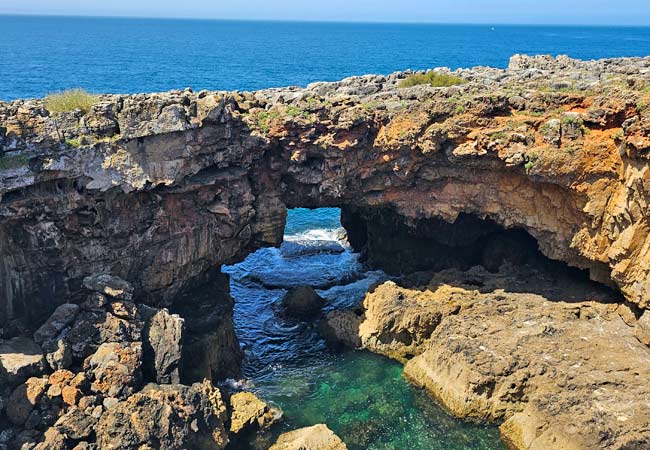
The sea arch and chasm of the Boca do Inferno on a calm summer day
I have visited and lived in Lisbon since 2001, and I consider the walk from the centre of Cascais to the Boca do Inferno to be one of the most scenic in the region. I highly recommend this short walk for your trip to Cascais, along with taking time to explore the cliff coastline.
At the Boca do Inferno you will also find the Mar do Inferno, one of the finest seafood restaurants in Cascais and a personal favourite of mine. Nearby, the Mercadinho Boca do Inferno sells regional handicrafts and gifts at prices well below the tourist shops in town.
If you are on holiday in Cascais, or simply staying late, I would personally recommend visiting at sunset, when the sun sinks below the ocean and the sky is illuminated in orange glows. It is simply magical.
Related articles: Cascais guide - Day trip to Cascais
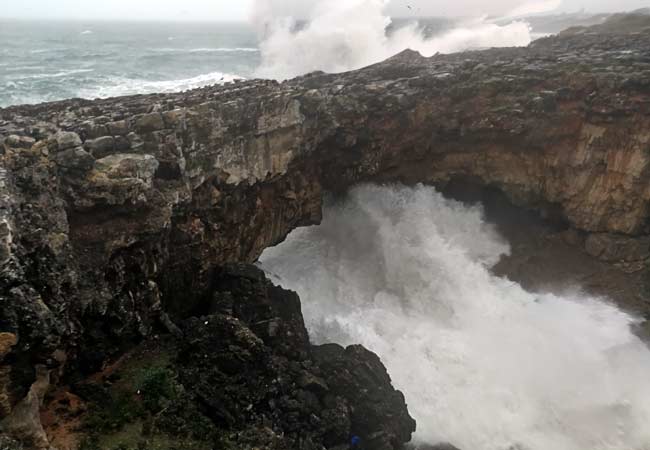
Ferocious winter waves crashing through the sea arch

Seaward entrance to the Boca do Inferno as seen from the cliffside viewpoint.
Boca do Inferno tourist information
The Boca do Inferno is free to visit, and there is no entrance fee for the viewing platform.
I do want you to have realistic expectations about the Boca do Inferno. It is an interesting cliff feature, but it certainly cannot rival the Benagil Cave in the Algarve or the Ponta da Piedade in Lagos. In my opinion, the Boca do Inferno is best appreciated as the end point of a scenic coastal walk, rather than somewhere you should travel all the way from Lisbon to purposely visit.
A typical visit is 20 minutes, but if you are visiting as part of an organised tour, 10 minutes is sufficient to see the cliffs and sea arch.
The Boca do Inferno is best seen on a stormy winter's day, when the waves crash through the sea arch. On a calm summer's day, the experience can feel a bit tame.
During the winter or in storms, the viewpoint may be closed. Even in good weather, the cliffs can be dangerous, and there have been many occasions when people have been swept off or have slipped down them.
Insight: I often hear tourists mixing up the Boca do Inferno with the Cabo da Roca, which is the most westerly point of mainland Europe and is 13km to the north. The Boca do Inferno is not the most westerly point of Europe.
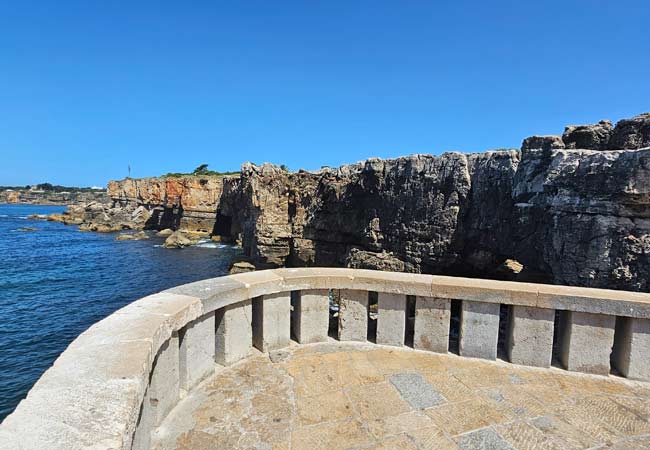
The viewing platform is a magical location to watch the sunset out across the Atlantic Ocean
The Boca do Inferno lies 2km to the west of Cascais and is a popular 20-minute walk from the centre of the town.
The best walking route follows the coastal road (the Avenue Rei Humberto II de Itália) westwards out of Cascais, passing the Condes de Castro Guimarães Museum and Santa Marta Museum. The route is flat and suitable for all. The path is wide enough that it also serves as a cycle path, leading all the way to Guincho Beach. This is a pleasant cycling route when there are no strong winds, which can be surprisingly fierce, and is another highly recommended activity for a longer holiday.
A taxi from the train station would cost between €7 and €9, but finding one for the return journey can be difficult. I am a frequent user of Uber and Bolt, and the €4–5 fare would be my preferred option. I have used this many times with my ageing parents at the end of a day trip.
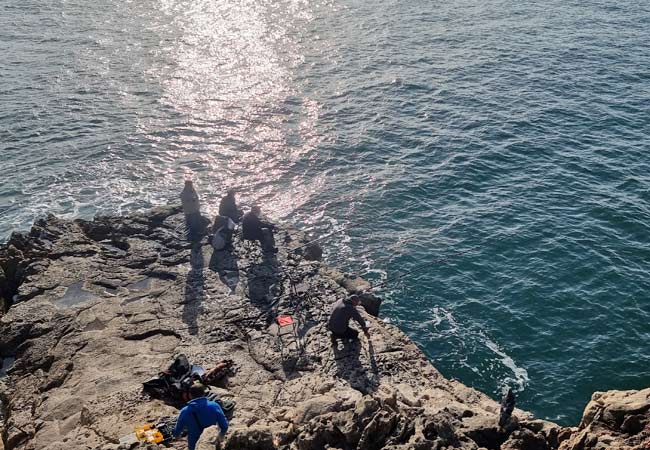
While the waves are calm, the Cascais cliffs are a favourite location for fishing.
Warning: While at the Boca do Inferno, you will see locals fishing at the very edge of the cliffs. Do not follow their example; these cliffs are very dangerous
Close to the Boca do Inferno is the Mercadinho Boca do Inferno, a series of market stalls that sell local handicrafts and gifts. This is a great place to purchase gifts and traditional Portuguese products, and I find prices tend to be cheaper than in the tourist shops in the centre of Cascais.
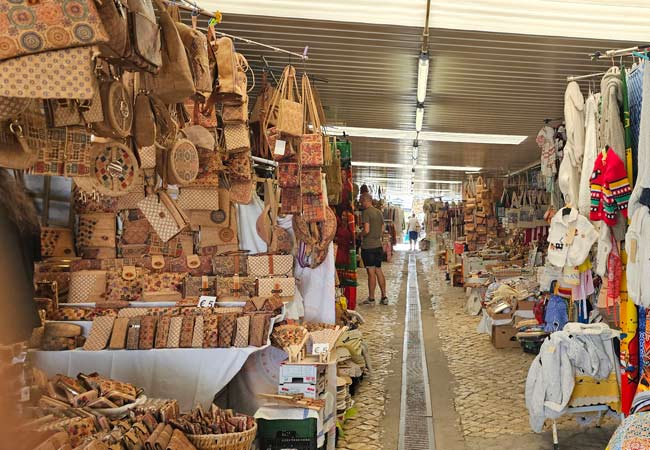
The handicraft stalls of the Mercadinho Boca do Inferno
There is a selection of cafes and kiosks at the Boca do Inferno, but the standout is the excellent Mar do Inferno, a restaurant that specialises in seafood with a romantic sea-view setting. The food is so good that I have been here for special occasions. Their menu can be seen on their website:
https://www.mardoinferno.pt/
For a less expensive meal option, consider the café next door, the Rocha do Inferno, which has been run by the same family for over 80 years.
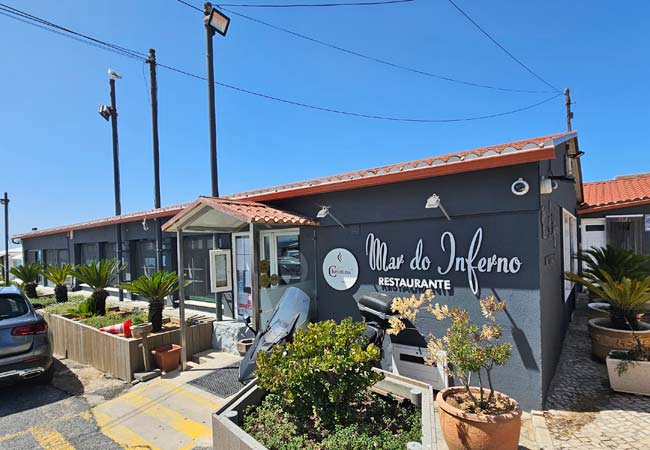
The Mar do Inferno restaurant.
The formation of the Boca do Inferno
The gnarled and jagged cliffs of the Costa da Guia are formed from Cretaceous-age limestone, dating back roughly 90 to 100 million years. Despite being very resistant to the power of the ocean, the limestone is slowly eroded by two key processes. Rainwater, made slightly acidic by dissolved carbon dioxide, gradually dissolves the rock over millennia, while salt from sea spray crystallises within cracks, expanding and breaking the stone apart from within. Together, these processes create the strange, pitted shapes visible across the cliffs.
The cliffs appear dark grey rather than the white or cream typically associated with limestone. This darkening is caused by colonies of algae, cyanobacteria, and lichens that thrive in the damp, salt-sprayed coastal environment, along with mineral staining from the constant wetting and drying of seawater.
The Boca do Inferno was formed by the erosion of a weaker vein of limestone in the cliff face. Powerful waves forced air into cracks in this softer rock, and the repeated compression and decompression gradually hollowed out a large sea cave. The more resistant outer rock remained, while the weaker interior was eroded to such an extent that the roof eventually collapsed, forming the chasm and sea arch seen today.
This process is still ongoing, and the Boca do Inferno is very slowly widening with each passing year.
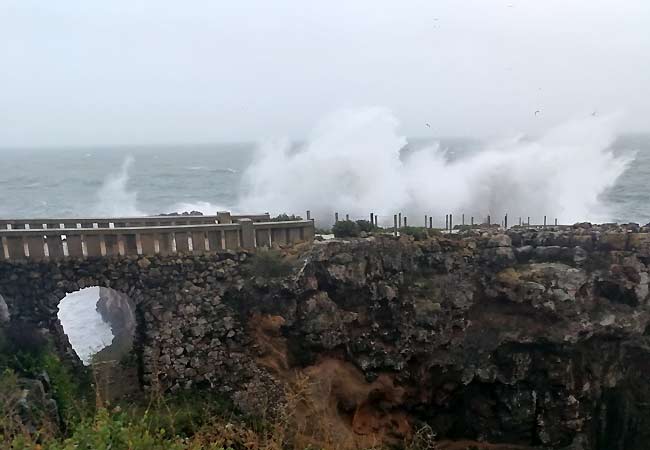
During the winter, the waves crash into the Costa da Guia coastline
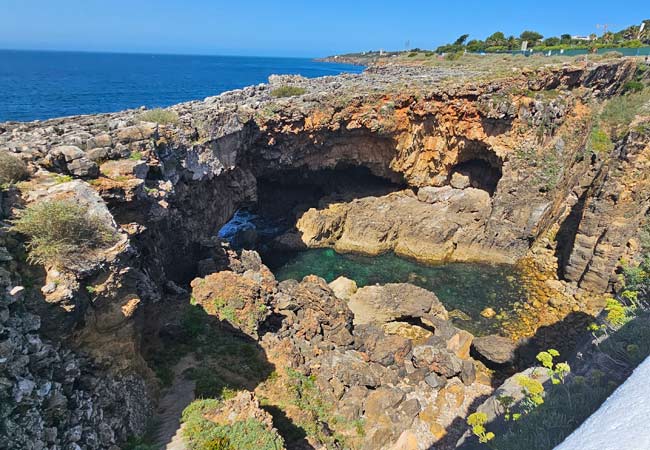
The interior of the opening has been eroded at differing rates
The Boca do Inferno has also attracted its share of notoriety. In 1930, Aleister Crowley, a magician, astrologer, and mystic, faked his own death at the Boca do Inferno in Cascais. As part of the stunt, he secretly left Portugal to reappear three weeks later at an exhibition of his work in Berlin. The story was wildly and enthusiastically reported in the newspapers of the era and helped promote his work.
Our most popular guides for Cascais and the Lisbon region


Expert Insight: These guides are curated by Philip Giddings, a travel writer with over 25 years of local experience in Portugal. Since 2008, Phil has focused on providing verified, on-the-ground advice for the Cascais region, supported by deep cultural ties through his Portuguese family. Read the full story here.
Cascais-Portugal.com, Sintra-Portugal.com and Lisbon-Portugal-Guide.com with over 800 pages,
if its not here its probably not in Cascais, Estoril or the Lisbon coastline!
 -
-


If you've found our content valuable, we'd welcome your support.
The digital publishing landscape has evolved significantly. As a small independent publisher, we face growing challenges. Search engines increasingly favour paid content over organic results, while AI-generated content often reproduces original work without attribution.
To support our work, please consider bookmarking this page (press Ctrl + D) for quick access. If you find an article helpful, we'd be grateful if you'd share it with friends on social media.
For specific questions, please see our Reddit community at r/LisbonPortugalTravel.
Should you notice any outdated or incorrect information, please contact us at [email protected]
Thank you for helping us continue to provide valuable content in an increasingly challenging digital environment.