Cascais-Portugal.com
The best independent guide to Cascais
Cascais-Portugal.com
The best independent guide to Cascais
Torre do Bugio, Cascais
The Torre do Bugio is a fortified light house that stands in the centre of the Tejo estuary. The fort was constructed in the 16th century to protect Lisbon’s harbours from North African raiding forces.
Today the Torre do Bugio is equally as important as a lighthouse, warning shipping of the large sand bar island that lies below the water line. The monument is not open to the public but can be clearly seen from the Cascais-Estoril coastline.
Torre do Bugio Style and Intresting Facts
The solid stone walls of the Torre do Bugio make a perfect circular doughnut surrounding the tall single tower. The whole complex was constructed in the Renaissance fortification style with the circular design offering improved coverage of artillery fire. The unique doughnut shape of the fort provided also provided resistance to the constant shifting sand bar caused by river and tidal forces.
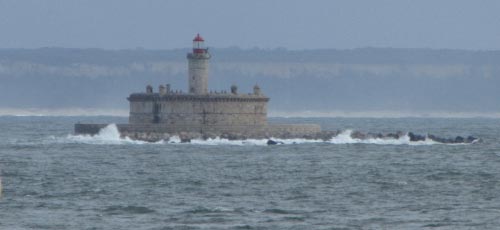
TheTorre do Bugio in the winter storms
The entire fort complex is called the Forte de São Lourenço do Bugio which is situated on the Cabeça Seca sand bar but the site is commonly just referred as the Torre do Bugio which is the lone tower at the heart of the fort. The Forte de São Lourenço do Bugio is managed by the Portuguese government and is not open to visitors but can be easily seen from the Lisbon-Cascais coastline.
History of the Torre do Bugio Cascais
The original strategic idea of the Torre do Bugio was to create a crossfire situation against invading ships and prevent landing close to Lisbon. The initial structure, built in 1570, was constructed of wood but due to the shifting sandbars was not practical.
In 1585 Lisbon was under a constant threat from raiding pirates and a more substantial stone structure was constructed. The Torre do Bugio was constructed in unison with the São Julião da Barra fort (on the north bank of the Tagus Estuary) and both forts could fire on ships entering the Tagus estuary.
The Torre do Bugio was constructed to support the Torre Belém which was located at the mouth of the Tagus estuary. The Torre do Bugio was constructed to be functional and is not as decorative as the small fort in Belém.
The Torre do Bugio was significantly damaged during the 1755 earthquake and once rebuilt the purpose was transformed into a lighthouse primary over as a defensive position. The entire complex is managed by the government is not open to visitors but can be easily seen from the Lisbon-Cascais coastline.
Our most popular guides for Cascais and the Lisbon region


About the Author: I'm Philip Giddings andI live in Graça (Lisbon) with my Portuguese wife Carla, whose family have been Lisboetas for generations. I've been visiting Portugal since 2001, writing independent guides at Cascais-Portugal.com since 2009, and the site is now my full-time work. I visited Cascais on my first trip to Lisbon as a teenager and Carla was so proud to show off her country. Twenty-five years later married, with a bigger family and a few grey hairs, we are still heading to the same beaches in Cascais and walking the same coastal promenade on a hot summer's day.
This site has 32 guides on Cascais and the surrounding region. It takes no payment from tourist boards, tour operators, or attractions for inclusion, and is funded by affiliate commissions on tour bookings, disclosed on every page that contains them. Every practical detail (ticket prices, opening hours, bus routes, time-slot policies) is checked against the official sources and verified in person on the walks I make through the town each week. Read my full bio here.
Cascais-Portugal.com, Sintra-Portugal.com and Lisbon-Portugal-Guide.com with over 800 pages,
if its not here its probably not in Cascais, Estoril or the Lisbon coastline!
If you've found our content valuable, we'd welcome your support.
The digital publishing landscape has evolved significantly. As a small independent publisher, we face growing challenges. Search engines increasingly favour paid content over organic results, while AI-generated content often reproduces original work without attribution.
To support our work, please consider bookmarking this page (press Ctrl + D) for quick access. If you find an article helpful, we'd be grateful if you'd share it with friends on social media.
For specific questions, please see our Reddit community at r/LisbonPortugalTravel.
Should you notice any outdated or incorrect information, please contact us at [email protected]
Thank you for helping us continue to provide valuable content in an increasingly challenging digital environment.