Cascais-Portugal.com
The best independent guide to Cascais
Cascais-Portugal.com
The best independent guide to Cascais
A day trip to Cascais; a 1-day itinerary and tour for 2026
Cascais is a charming beachside town that makes a fantastic choice for a day trip if you’re based in or around Lisbon. Found within Cascais are grand 19th-century villas, a pretty harbour, fascinating museums and glorious beaches.
Cascais was historically a minor fishing town, but this all changed in 1870 when King Luís I decreed that it would become his summer residence. This influx of nobility and the Portuguese elite transformed Cascais into a sophisticated and refined resort town, with impressive villas being constructed along the beachfront and within the town itself.
This exclusivity continues today, and Cascais remains one of the most desirable destinations in the Lisbon region. It offers an elegant blend of fishing heritage, 19th-century grandeur and the excitement of modern tourism.
My Portuguese wife and I have been visiting Cascais together since 2001, and even now that we live in Lisbon, it still draws us back regularly. For a hot summer's day wandering the promenade, for the first beach trip of the year to the sheltered Praia da Rainha, or to watch a winter storm batter the Boca do Inferno cliffs.
This guide provides everything you need for the perfect day trip to Cascais from Lisbon, and every recommendation is based on our personal experience of over two decades of visits.
Highlights of your day trip to Cascais
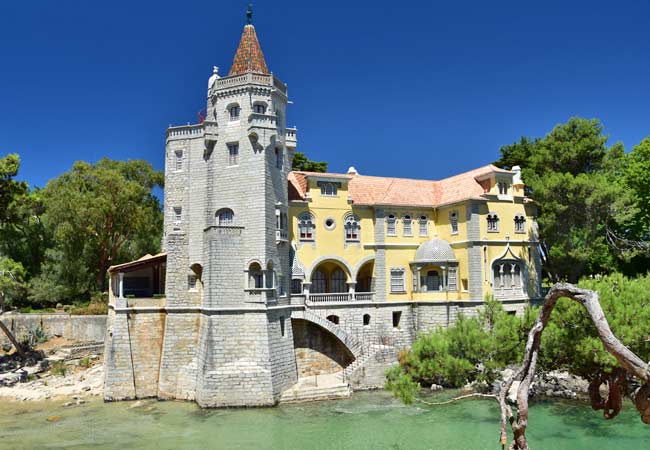
The Condes de Castro Guimarães - A wondrous and extravagant 19th-century villa sitting on the edge of Marechal Carmona park. Its bright yellow exterior and decorative towers have helped it become the icon of Cascais.
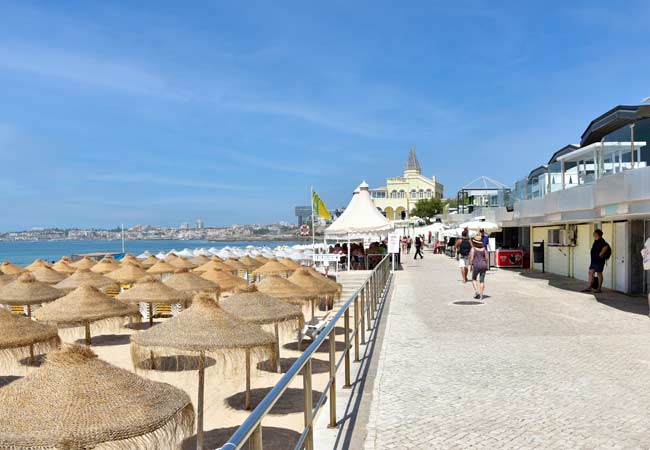
The Paredão de Cascais - The pretty coastal footpath that connects Cascais to Estoril, passing the region's many beautiful sandy beaches. This is one of my favourite walks on a sunny day, with a mixture of sights and vibrant holiday atmosphere.
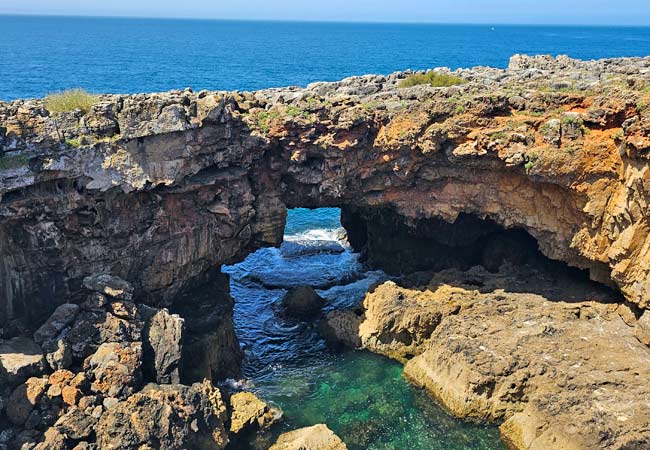
The Boca do Inferno – A unique cliff formation on the rugged coastline to the north of Cascais. The collapsed cave may appear tame on a summer's day, but during a violent winter's storm it deservedly earns its name, Hell's Mouth (Boca do Inferno).
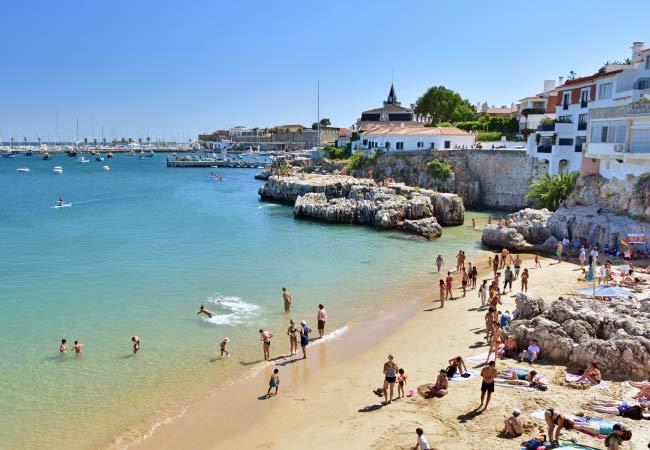
The Praia da Rainha - A small, picturesque beach concealed within the Cascais coastline. The beach is so pretty that in 1889 it was chosen by Queen Amélia as her private beach. Just don't go expecting it to be deserted.
Is Cascais the right day trip destination for you?
Cascais is a fantastic destination for a day trip from Lisbon. The town's varied selection of historic buildings and beautiful beaches, along with its vibrant atmosphere, means it will appeal to a wide range of tourists.
Part of this appeal is that Cascais works equally well as a beach destination and as a town full of sights. The morning could be spent exploring the historic centre and museums, and when the temperature rises in the afternoon you can relax on one of the sandy beaches.
It is a great choice for couples where one person prefers the beach and the other gets restless. My wife can happily lay on the Praia da Duquesa beach for the hot afternoon while I'm exploring one of the air-conditioned museums or having a cold drink under the shade in Marechal Carmona park.
All of the main tourist attractions in Cascais can be easily walked between, with none of the steep hills that you would encounter in Lisbon and Sintra. As Cascais is a bustling resort town, there is a wide selection of restaurants, bars and shops to choose from, and the town is connected to Lisbon by a direct and inexpensive train service.
My opinion: Your first day trip from Lisbon should be to Sintra, and Cascais second. As a beach destination, Cascais is far superior to the modern and bland Costa da Caparica, and is much easier to travel to than the surfing town of Ericeira.
Related articles: Sights of Cascais
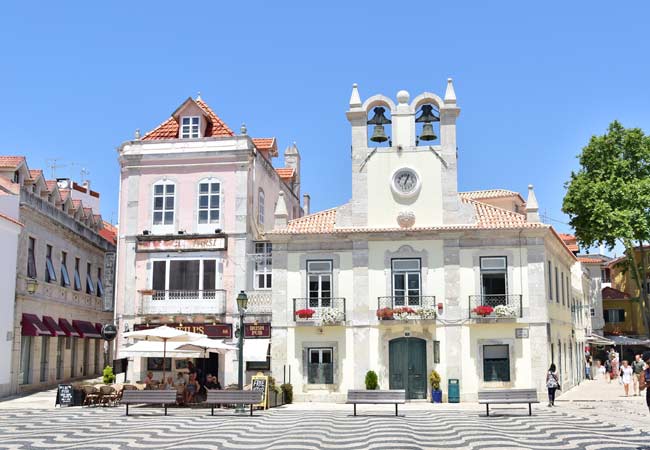
The Praça 5 de Outubro is the heart of Cascais
A suggested 1-day tour of Cascais
The map below displays a suggested day trip to Cascais and this is the route we have shown friends and family when they visit us in Lisbon. The tour begins at Cascais train station and ends at Estoril train station, where it is possible to catch the same train back to Lisbon.
There is no single must-see attraction in Cascais, but what makes it such a satisfying day trip is the sheer number of interesting sights you'll pass as you walk through the town. Most of the 25 stops on this tour are things you'll naturally walk past rather than places that need a dedicated visit.
The total tour is 11km, but it can be reduced to 3.2km if you don't include the walk to the Boca do Inferno or along the coastal promenade to Estoril. (Note: zoom out to see all of the points)
Legend: 1) Cascais train station 2) Rainha beach 3) Rua Frederico Arouca 4) Palácio Seixas 5) Ribeira beach 6) 5 de Outubro Plaza 7) Cascais fort 8) Cascais cultural centre 9) Cascais Marina 10) Condes de Castro villa 11) Marechal Carmona park 12) Casa de Santa María 13) Cascais lighthouse 14) Boca do Inferno 15) Paula Rego art gallery 16) Sea museum 17) Igreja da Assunção 18) Largo Luís de Camões 19) Conceição beach 20) Duquesa beach 21) Palmela Villa 22) Alberto Romano sea swimming pool 23) Forte da Cruz and Tamariz beach 24) Estoril Casino 25) Estoril train station
Insight: One of the most unique sights of the Cascais region is the Cabo da Roca headland, the most westerly point of mainland Europe. This is more a place to say you've been to than a destination to spend time at, as within 20 minutes everything can be easily seen. It does require a bit of effort to get there, either a slow bus journey (the 1624, 27 minutes) or a return Uber/Bolt ride (around €12 each way). If you go, be prepared for strong winds and for it to be noticeably cooler than Cascais.
Related article: The Cabo da Roca
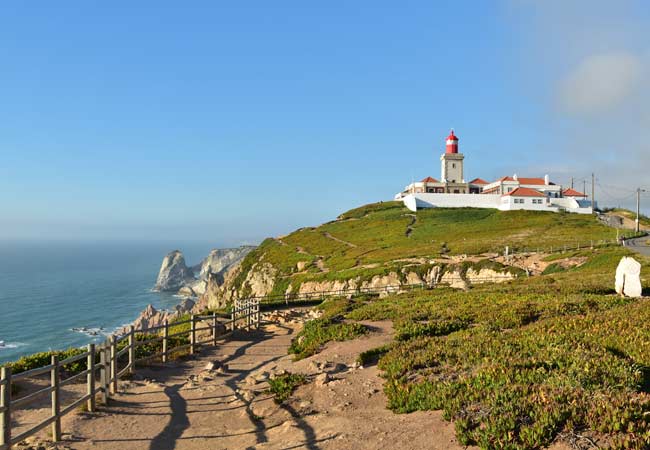
The powerful lighthouse at the Cabo da Roca
Lisbon to Cascais for a day trip
It is very easy to travel to Cascais from Lisbon, as they are connected by a direct, regular and inexpensive train service. The train departs from the Cais do Sodré train station in Lisbon, which is connected to the green metro line. The train journey to Cascais costs €2.55/€5.10 single/return and takes 40 minutes.
This journey will feel much shorter as it is very scenic and follows the coastline west from Lisbon. Always try to sit on the left side (south-facing) of the carriage when departing Lisbon for the best views of the coastline. The train will be very busy in the summer as everyone heads to the beach, but by Carcavelos (the main beach of the region) the train will be much emptier.
For your day trip you may prefer to catch an Uber or Bolt, with the convenience of door to door travel. The fare is surprisingly cheap at around €28 for up to 4 people. The only issue is that there can be very high demand around evening rush hour, so fares may be much higher along with longer waits to find drivers. This demand is even higher at the weekend when the whole of Lisbon wants to come back from the beach!
Related articles: Lisbon to Cascais

The train from Lisbon to Cascais
Cascais or Sintra?
Another popular day trip destination within the Lisbon region is the town of Sintra, set within the cool, forested hills of the Serra de Sintra. Sintra has extravagant villas, ancient castles and the magnificent Palácio Nacional da Pena, and overall it has many more varied sights and attractions than Cascais.
In my opinion, you should visit Sintra first. However, be aware that Sintra is physically and mentally draining as a day trip. The endless jostling of the hordes of tourists, the lack of flexibility as tickets have timed entry, and everywhere you go will feel as if it is uphill. Cascais is the opposite: relaxed, flat and easy going, with beaches to collapse onto when you've had enough sightseeing.
Insight: Never try to combine Sintra and Cascais in a single day of sightseeing. Each town needs at least one day to fully appreciate, and Sintra really needs two.
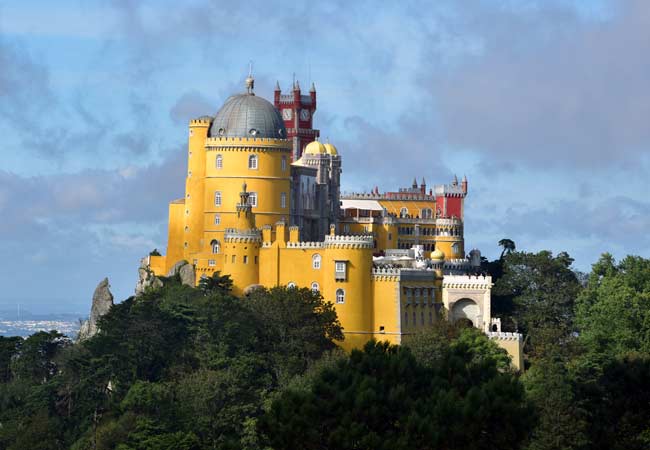
The beautiful Palácio Nacional da Pena in Sintra is one of the finest tourist attractions in Portugal
If you have limited time or would prefer to avoid the hassle of public transport, an organised tour is a fantastic way to discover both Cascais and Sintra in a single day. A tour with a driver and guide removes all of the stress of navigating Sintra's steep hills and timed tickets, while still covering the highlights of both towns.
We have partnered with GetYourGuide for the past seven years, and some of their best tours of Cascais and Sintra include:
A tour of Cascais for a day trip
The tour begins at the railway station (1). The first sight you will see is the pretty Praia da Rainha beach (2), with this secluded location having once been a favourite with Queen Amélia during the 1890s.
From the beach, wander down the bustling shopping street of Rua Frederico Arouca (3), which leads into the historic centre of Cascais. The Cidade Velha is filled with grand 19th-century buildings, such as the Palácio Seixas (4), which overlooks the popular Praia da Ribeira beach (5).
The Praça 5 de Outubro (6) is the main plaza of Cascais, and found here are the town hall and a statue of King Pedro I. To the rear of the plaza are numerous shops and restaurants if you are seeking refreshments or food.
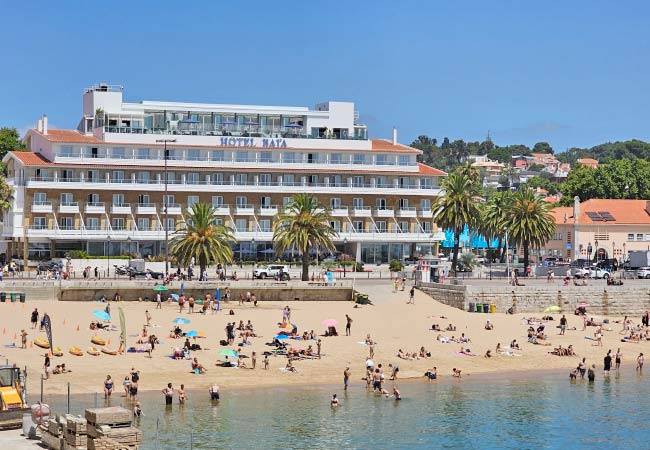
The Praia da Ribeira beach at the centre of Cascais
The tour continues by wandering past the fishing harbour to the impressive Fortress Nossa Senhora da Luz de Cascais (7). This historic fort has now been transformed into an upmarket artisan centre.
A walk around the perimeter of the fort's walls takes you past the colourful Centro Cultural de Cascais (8) (€5 admission), ending at the exclusive Cascais marina complex (9).
The Museu Condes de Castro Guimarães (10) (€4 admission) is the most elegant building in Cascais. Behind the 19th-century villa is the Parque Marechal Carmona (11), with its duck lakes and peaceful gardens. The Casa de Santa María (12) is another grand villa, which sits next to the blue and white Santa Marta lighthouse (13).
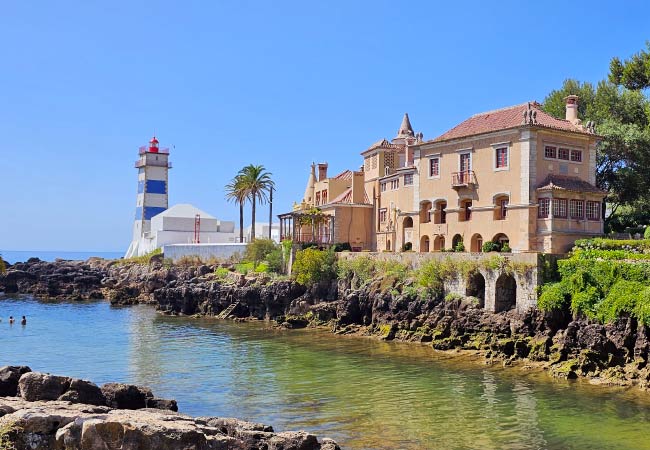
The Casa de Santa María and lighthouse
The next section follows the coastal road for 800m to the Boca do Inferno (14), a sea arch and collapsed cave onto which powerful Atlantic waves crash.
The Casa das Histórias Paula Rego (15) (€5 admission), displays the powerful work of figurative artist Paula Rego. Next door is the Sea Museum (16), detailing the fishing heritage of Cascais.
The walk back into the town centre passes the Igreja da Assunção (17) and the neo-classical Casa Sommer.
The centre of Cascais is a convenient location for lunch, with many food options along the Rua Visconde da Luz (18) or near the Jardim Visconde da Luz.
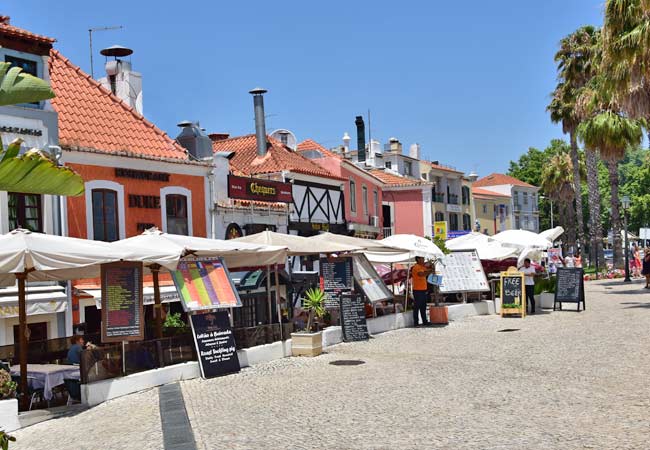
There’s many places in Cascais for lunch
For the latter part of the day, we’d suggest a walk along the Paredão de Cascais, a scenic coastal promenade between Cascais and Estoril. From the Praia da Duquesa it is 1.7km to Estoril train station, where a train can be caught back to Lisbon.
The promenade first passes the two busiest beaches of the Cascais region, the Praia da Conceição (19) and Praia da Duquesa (20), which will be crowded with tourists in the summer. Standing on the headland is the mock-gothic Palácio dos Duques de Palmela (21). Beyond the headland is the Piscina Oceânica Alberto Romano (22), a seawater swimming pool.
The promenade ends at the Forte da Cruz and the Praia do Tamariz beach (23) in Estoril. Estoril has a reputation for sophistication and is famed for the Estoril Casino (24). The tour concludes at Estoril train station (25).
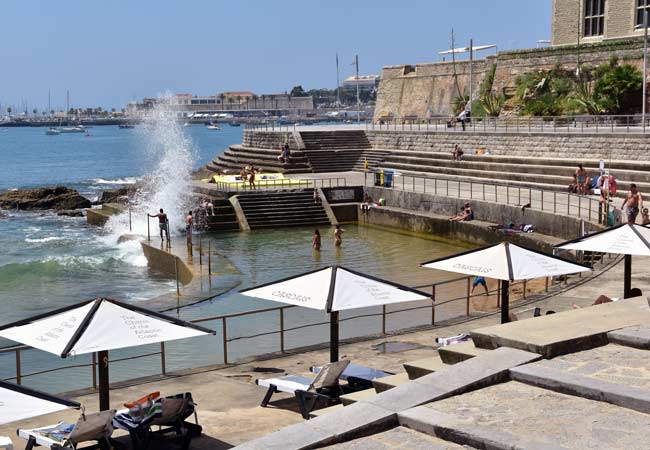
The Alberto Romano sea swimming pool

The Casino Estoril
If you have a car
There is no need for a rental car for a day trip to Cascais, but if you do have one you could add the following sights:
• Casa da Guia, an upmarket shopping area set within the grounds of a stately house. There are many good food options here
• The scenic drive along the N247 road between Azóia and Almuinhas Velhas
• The stunning scenery of Guincho beach
• Cabo da Roca, the westernmost point of mainland Europe
• Santuário da Peninha, a little chapel and best view point of the Serra de Sintra region
• Forte de São Jorge de Oitavos, a small fort north of Cascais
Note: There is very limited car parking in Cascais, especially in the summer - we never recommend driving to Cascais for a day trip.
Our most popular guide for Cascais and Lisbon


About the Author: I'm Philip Giddings andI live in Graça (Lisbon) with my Portuguese wife Carla, whose family have been Lisboetas for generations. I've been visiting Portugal since 2001, writing independent guides at Cascais-Portugal.com since 2009, and the site is now my full-time work. I visited Cascais on my first trip to Lisbon as a teenager and Carla was so proud to show off her country. Twenty-five years later married, with a bigger family and a few grey hairs, we are still heading to the same beaches in Cascais and walking the same coastal promenade on a hot summer's day.
This site has 32 guides on Cascais and the surrounding region. It takes no payment from tourist boards, tour operators, or attractions for inclusion, and is funded by affiliate commissions on tour bookings, disclosed on every page that contains them. Every practical detail (ticket prices, opening hours, bus routes, time-slot policies) is checked against the official sources and verified in person on the walks I make through the town each week. Read my full bio here.